What Is a CDR Report? Complete Guide for Engineers Australia Skills Assessment
Learn what a CDR report is, who needs it for Engineers Australia skills assessment, what documents are required, and how to avoid common CDR mistakes.
What Is a CDR Report? Complete Guide for Engineers Australia Skills Assessment
If you are an engineer planning to apply for an Australian skills assessment, you may have heard the term CDR Report many times. For many overseas-qualified engineers, the Competency Demonstration Report, commonly called a CDR, is one of the most important documents in the Engineers Australia assessment process.
A well-prepared CDR does more than describe your academic background. It shows how your engineering knowledge, technical decisions, problem-solving ability, and professional experience align with the competency standards expected in Australia.
In this guide, CDR Writers Nepal explains what a CDR report is, who needs it, what documents are usually included, and how to prepare it professionally.
What Is a CDR Report?
A Competency Demonstration Report (CDR) is a technical documentation package prepared for Engineers Australia as part of the Migration Skills Assessment process.
It is usually required when an engineer’s qualification is not directly accredited under recognised engineering education accords or when the applicant needs to demonstrate competency through project-based evidence.
In simple words, a CDR explains:
- what engineering work you have done,
- what problems you solved,
- what technical decisions you made,
- what standards, tools, methods, or calculations you used,
- and how your experience matches the nominated engineering occupation.
The CDR is not just a normal CV or project summary. It must be written in a structured way and should clearly highlight your personal engineering contribution.
Who Needs a CDR Report?
You may need a CDR report if you are applying for Engineers Australia skills assessment and your qualification does not fall under a direct accredited pathway.
A CDR may also be needed if:
- your engineering degree is from a non-accredited institution,
- your qualification title is different from your nominated occupation,
- your academic background needs additional competency evidence,
- you are applying under an engineering occupation that requires detailed technical demonstration,
- or you need to show that your knowledge and experience match Australian engineering standards.
For Nepali engineers, this is especially important because many applicants must present their academic projects, professional experience, and engineering competencies through a strong CDR package.
Main Parts of a CDR Report
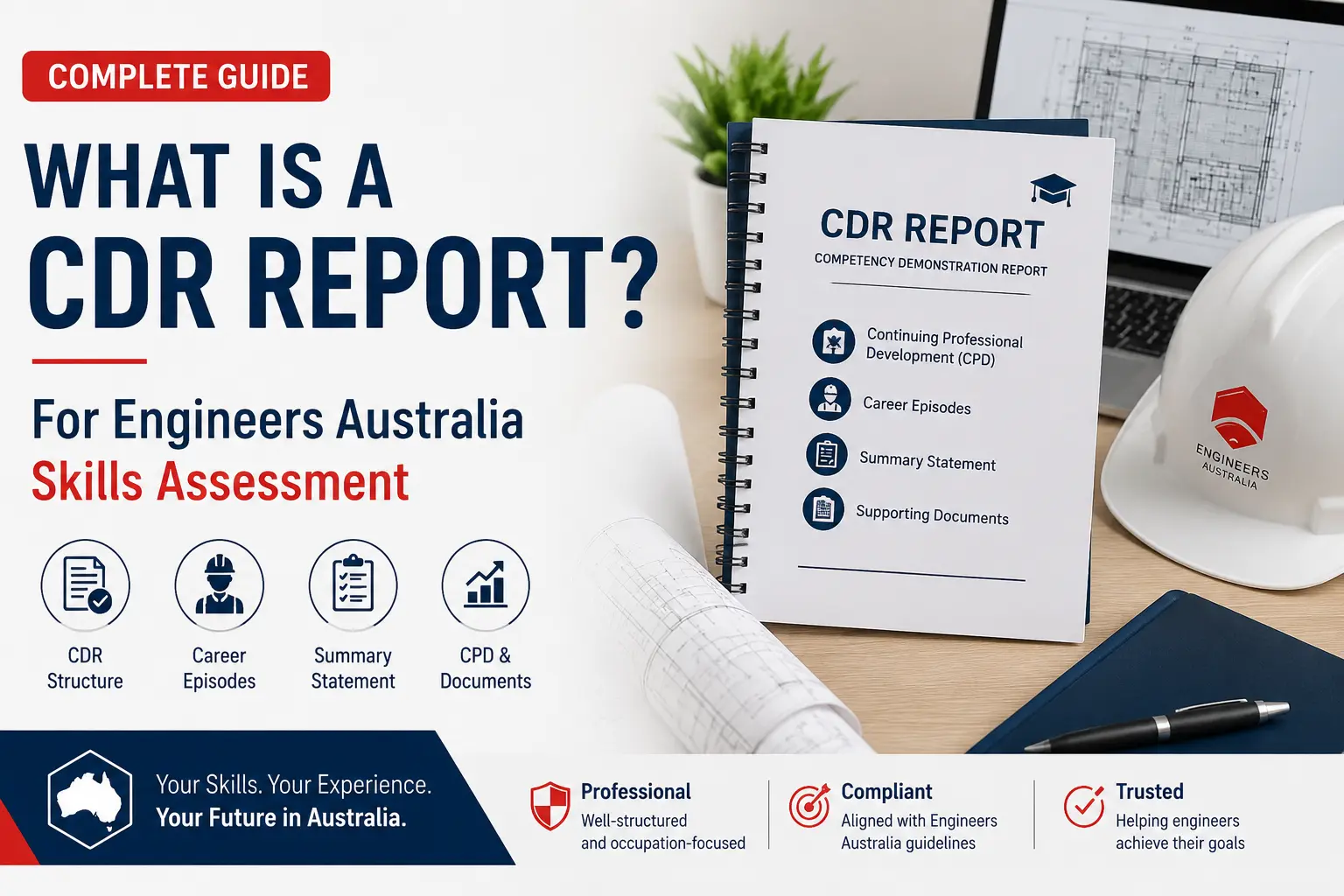
A complete CDR package usually includes several important documents. Each section has a specific purpose and must be prepared carefully.
1. Continuing Professional Development CPD
The CPD section shows how you have continued learning after your formal education. It may include training, workshops, seminars, online courses, professional reading, technical conferences, or industry learning activities.
A strong CPD list should be clear, relevant, and professionally formatted. It should show that you are committed to improving your engineering knowledge.
2. Three Career Episodes
Career Episodes are the most important part of the CDR. Each Career Episode describes one engineering project, task, or work experience in detail.
You normally need three separate Career Episodes. Each one should focus on your individual role and contribution.
A good Career Episode should explain:
- the background of the project,
- your specific engineering responsibilities,
- the technical problems you faced,
- the tools, calculations, standards, or software you used,
- the engineering decisions you made,
- and the final outcome of your work.
The key point is this: Career Episodes must focus on what you personally did, not only what the team or company achieved.
3. Summary Statement
The Summary Statement connects your Career Episodes with the required competency elements. It cross-references specific paragraphs from your Career Episodes and shows where each competency has been demonstrated.
This section must be very accurate because it works like a competency map. If the references are weak, unclear, or mismatched, the overall CDR quality can suffer.
4. Academic and Professional Documents
Along with the written CDR, applicants may also need to provide academic transcripts, certificates, CV, employment documents, identification documents, English test results if required, and other supporting evidence depending on the assessment pathway.
Always check the latest official requirements before submission because document rules may change.
Common CDR Mistakes to Avoid
Many applicants prepare a CDR without understanding how technical and structured it needs to be. This can lead to delays, additional information requests, or rejection risks.
Common mistakes include:
- writing general project descriptions instead of personal engineering contribution,
- copying content from samples or online sources,
- using weak technical explanations,
- not matching Career Episodes with the nominated occupation,
- poor Summary Statement mapping,
- missing engineering calculations, standards, tools, or problem-solving details,
- using team-focused language instead of first-person engineering actions,
- and submitting poorly edited or unclear writing.
A professional CDR should sound authentic, technical, and evidence-based. It should not look like a generic template.
Why a Strong CDR Matters
Your CDR is one of the main documents used to understand your engineering competency. A strong report can present your experience clearly and professionally, while a weak report can create confusion even if you have good qualifications and experience.
A strong CDR helps demonstrate:
- your engineering knowledge,
- your practical problem-solving ability,
- your understanding of professional responsibility,
- your ability to communicate technical information,
- and your suitability for the nominated engineering occupation.
For engineers who are serious about Australian skills assessment, the CDR should be treated as a professional technical portfolio, not just a writing task.
How CDR Writers Nepal Can Help
CDR Writers Nepal supports engineers with professional CDR report preparation, Career Episode writing, Summary Statement mapping, CPD formatting, plagiarism review, technical editing, and document guidance.
Our focus is to prepare clear, personalised, and occupation-relevant CDR documents based on your real academic projects and professional experience.
We help engineers from different fields, including:
- Civil Engineering
- Mechanical Engineering
- Electrical Engineering
- Electronics Engineering
- Computer Engineering
- Industrial Engineering
- Engineering Technologist roles
- Engineering Associate roles
- Draftsperson and Technician occupations
Every CDR should be prepared according to the applicant’s actual background, nominated occupation, and available evidence.
Final Thoughts
A CDR report is one of the most important documents for many engineers applying for Engineers Australia skills assessment. It must be accurate, technical, original, and clearly connected to your nominated occupation.
If you are unsure how to start your CDR, the best step is to review your academic projects, work experience, engineering tasks, and ANZSCO occupation carefully before writing.
Need help preparing your CDR report?
Contact CDR Writers Nepal for professional guidance and document support.
Disclaimer: CDR Writers Nepal provides CDR writing, editing, and document-support services. We do not provide migration legal advice. Applicants should always verify the latest requirements from official authorities before submission.